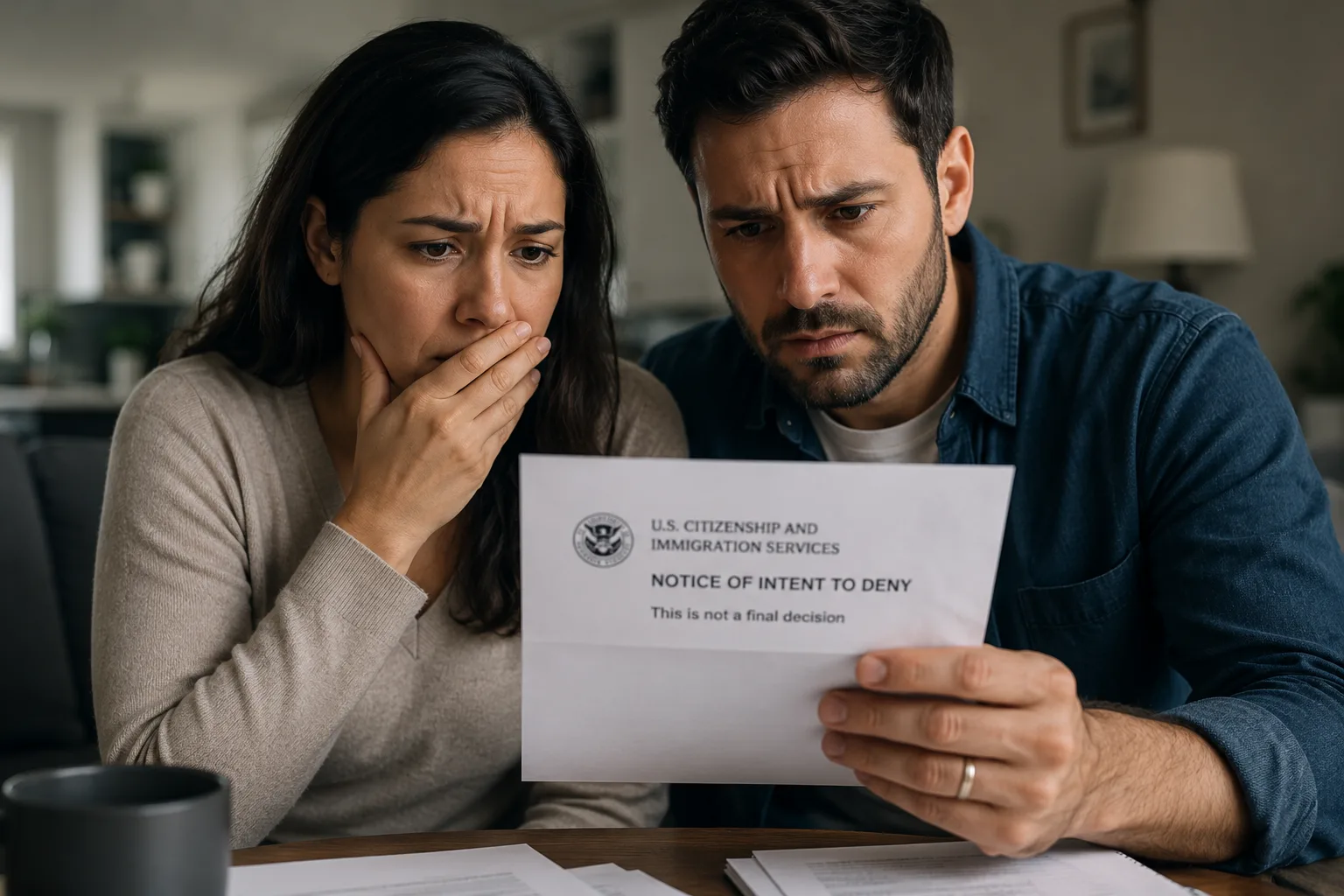
One of the more difficult consultations I had recently involved a married couple who came to see me after receiving something no couple wants to see from USCIS:
A Notice of Intent to Deny (“NOID”) on their marriage-based green card case.
By the time they walked into my office, they were understandably shaken.
Their case had already been through a difficult interview. At one point, they had been separated and questioned individually. There had been a field investigation. And now, after months of waiting and uncertainty, the government was signaling that it was not convinced.
When they sat down across from me, they began with a phrase I have heard many times over the years:
“We gave them everything.”
I believed that they believed that.
And that is exactly the point.
In my experience as an immigration attorney since 2008, many good, honest, genuinely married couples do not fail because they are hiding something. They often struggle because they underestimate just how detailed, evidence-driven, and psychologically demanding the immigration process can be.
And to be fair—this is incredibly common.
For most couples, applying for permanent residence through marriage is their first meaningful interaction with the U.S. immigration system. They are not lawyers. They are not investigators. They are not trained to think in terms of evidentiary records, credibility assessments, administrative discretion, or how seemingly minor inconsistencies can take on outsized importance once a case begins moving through the system.
They are simply living their lives.
They know their marriage is real.
To them, that feels like the most important fact.
But immigration law often asks a different question:
Can you prove your real life in a way that is organized, credible, consistent, and persuasive to a government officer who was not there to witness it?
That is a very different exercise.
Three Common Ways Genuine Couples Underestimate the Process
Over the years, I have noticed several recurring patterns.
1. They underestimate what “evidence” really means.
Many couples believe evidence means:
A few photographs.
A joint bank account.
Perhaps a lease.
Maybe some text messages.
Those things can absolutely help.
But in many cases—especially once questions arise—USCIS may be looking for something far broader and deeper: a consistent documentary story showing how two lives became intertwined over time.
That may include:
- Joint financial records
- Insurance policies
- Tax filings
- Employment records
- Travel history
- Family correspondence
- Medical records
- Emergency contacts
- School records
- Affidavits
- Shared obligations
- Evidence of day-to-day decision-making
Real life often leaves a paper trail. The challenge is recognizing it.
2. They underestimate the interview.
Many couples walk into their marriage interview assuming:
“We are telling the truth, so we will be fine.”
I understand that instinct.
But truth alone does not always prevent nervousness, memory lapses, poor communication, or misunderstanding.
A stressful interview environment can cause even honest people to:
- Answer too quickly
- Over-explain
- Guess instead of clarify
- Forget dates or timelines
- Mishear a question
- Become defensive
- Contradict one another on small details
And once concern is triggered, the interview may become more intensive.
Separate questioning is not automatically a sign of fraud. But it can become a moment where preparation, mindset, and communication matter enormously.
3. They assume that because the marriage is genuine, professional guidance is optional.
This is perhaps the most understandable assumption of all.
If your marriage is real, why would you need help proving it?
Because immigration is not simply about what is true.
It is also about how truth is documented, presented, organized, and defended.
That distinction matters.
The Consultation That Changed the Direction of the Case
What was supposed to be a routine 45-minute consultation turned into nearly an hour and a half of legal strategy.
As we carefully reviewed their history, documents, and the government’s concerns, something important began to happen:
New evidence started surfacing.
Not manufactured evidence.
Not “created for immigration” evidence.
Real-life evidence.
At one point, the couple remembered an emergency room visit involving a serious medical incident.
We dug deeper.
There it was:
Hospital records showing one spouse admitted for trauma… and the other spouse documented as present, involved, and by their side.
There were photographs as well.
You cannot manufacture moments like that.
By the end of our meeting, what began as:
“We already gave them everything.”
Had turned into:
A detailed checklist of more than twenty additional evidentiary items that, in my professional judgment, could substantially strengthen their response.
Will the case ultimately be approved?
No ethical lawyer can promise that.
But what I can say is this:
By the end of that meeting, the case told a very different story.
And at minimum, the record had become significantly stronger—not only for responding to the NOID, but if necessary, for appeal or even refiling.
If You Are Feeling Overwhelmed, You Are Not Alone
If you are reading this because your interview went badly… because you received a request for evidence… because you were separated during questioning… because investigators visited your home… or because a Notice of Intent to Deny just arrived—
Please understand:
You are not automatically doomed.
And you are certainly not the first genuine couple to underestimate how complex this process can become.
In many cases, the problem is not the relationship.
The problem is that the case never fully told the relationship’s story.
And sometimes, that story can still be told.
Final Thought
In my experience, what matters most in immigration is often not the fact you know…
It is the fact you never realized mattered.
This article is for general educational purposes only and does not constitute legal advice. Every immigration case is unique and should be evaluated based on its specific facts and procedural history.
