
2026 edition · Research cutoff: October 5, 2026
A source-based report from the Law Offices of Arsen V. Baziyants for families navigating immigration in Las Vegas and Southern Nevada. This edition examines selected federal developments and their practical consequences for marriage and family petitions, permanent residence, waivers, and citizenship. It also places those issues in Nevada’s demographic context.
The analysis below explains legal and procedural considerations. It does not report the firm’s case outcomes or claim that statewide population figures establish a trend in Las Vegas applications. The dates attached to each source matter: a rule’s effective date, a data period, and an interview-queue snapshot answer different questions.
In this report: Key findings · Nevada context · Family petitions · Adjustment of status · Consular processing · Conditional residence · Waivers · Naturalization · Legal analysis · Methodology
Key findings for 2026
1. Filing dates can change the applicable requirements. The September 18, 2026 public-charge rule and the October 20, 2025 naturalization-test filing threshold make the date of a submission consequential. Preparation should begin with the current form edition and the requirements applicable to that filing.
2. There is no single “family immigration wait time.” Petition adjudication, visa availability, document completion, and consular scheduling are separate stages. The Department of State’s post-by-post scheduling tool illustrates this distinction; its dates are queue indicators, not promises of an interview or approval.
3. A policy announced earlier in the year may no longer govern. The State Department reports that its January 2026 pause on immigrant visa issuance to nationals of 75 countries ended on August 21, 2026 under a court order. Relying on an older announcement without checking its current status can produce the wrong advice.
4. Nevada’s diversity is context, not an eligibility finding. Census estimates describe a substantial foreign-born population and many multilingual households. They do not identify who qualifies for a petition, adjustment, a waiver, or citizenship. The supporting sources and their limits appear below.
Nevada: the population context
The Census Bureau’s 2020–2024 estimates show that 19.1% of Nevada residents were foreign-born. Separately, 29.5% of people age five and older spoke a language other than English at home. The second measure has a different population base. Both are statewide estimates, not Las Vegas case statistics. Source: Census QuickFacts, Nevada.
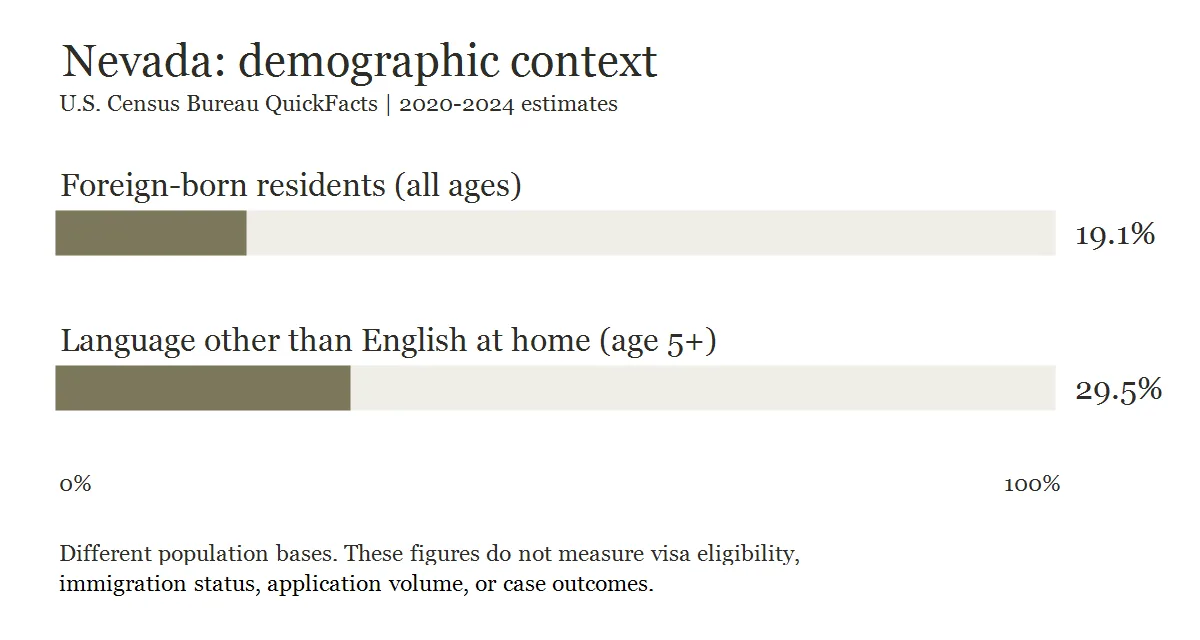
For a family preparing a case, the useful question remains individual: what is the relationship, the petitioner’s status, the applicant’s immigration history, and the legally available route? Population context cannot replace that assessment.
Family petitions: approval and visa availability are different
Form I-130 establishes the qualifying family relationship; its approval alone does not confer permanent residence or permission to remain in the United States. The route to a green card also depends on eligibility for adjustment of status or immigrant visa processing abroad. USCIS family-petition guide.
Immediate-relative and family-preference cases must be distinguished. The January 2026 Visa Bulletin states a 226,000 family-sponsored preference limit for fiscal year 2026; that is not a count of all family green cards and does not include the separate immediate-relative category. Preference applicants must examine the relevant category, country of chargeability, priority date, and applicable chart. January 2026 Visa Bulletin.
A January bulletin is not a substitute for the bulletin in effect when action is taken. Consult the current Visa Bulletin and, for adjustment, USCIS’s instructions identifying which chart may be used for that month. A date becoming current is a visa-availability event, not a guarantee that the underlying application will be approved immediately.
The practical consequence is to plan the petition and the later residence application together. Evidence of a genuine marriage matters, but so do entry records, prior filings, and any facts that affect admissibility or the chosen process.
Adjustment of status: a consequential September rule change
DHS’s final public-charge rule became effective September 18, 2026. The rule specifies its application to admission applications made on or after that date and adjustment applications postmarked or electronically submitted on or after that date. Its treatment of means-tested benefits received before the effective date follows the 2022 rule. Final rule and effective-date provisions, Federal Register.
USCIS also announced updated Form I-485 versions and stated that older versions would not be accepted for submissions on or after the effective date. USCIS July 16, 2026 announcement.
For preparation, this creates two separate checks: whether the correct form edition is being submitted and how the applicable substantive standard addresses the applicant’s facts. Neither a benefit’s name nor a single financial fact should be treated as a complete legal conclusion. The applicable ground, any exemption, relevant dates, and supporting evidence must be analyzed together.
Consular processing: location, queue dates, and changing policy
The State Department’s guidance directs immigrant visa applicants to interview in their country of residence or, if requested, their country of nationality, subject to limited exceptions. The stated implementation date is November 1, 2025; the announcement was updated July 15, 2026. A seemingly shorter queue at another post does not itself establish a right to transfer there. State Department interview-location guidance.
The following selected posts illustrate the Immigrant Visa Scheduling Status Tool, last updated September 23, 2026. The cells show the month and year of documentarily complete cases that NVC was generally scheduling—not interview dates, total case duration, or approval rates.
| Consular post | Immediate relatives | Family preference |
|---|---|---|
| Ciudad Juarez | December 2024 | August 2025 |
| Mumbai (Bombay) | March 2026 | February 2025 |
| Warsaw | July 2026 | June 2026 |
These categories and posts should not be ranked as though their caseloads were interchangeable. Visa availability and individual circumstances still matter. The tool excludes K-1 cases and cases with a pending I-601A waiver, and its snapshots do not guarantee a particular applicant’s scheduling date.
A separate policy update deserves attention: the State Department’s August 28, 2026 notice says the January 2026 issuance pause affecting nationals of 75 countries was no longer in effect as of August 21, 2026, under a court order in CLINIC et al. v. Rubio et al. That statement addresses this particular pause; it should not be read as eliminating every other restriction or admissibility requirement. State Department current-status notice.
Consular preparation should therefore confirm the assigned post, the completion of required documents, visa availability, and the policies currently applicable to the applicant. Historical articles and a single queue date are insufficient foundations for irreversible travel or departure decisions.
Conditional residence: protect the filing deadline
When permanent residence based on marriage is granted before the marriage is two years old, the residence is conditional. A joint Form I-751 ordinarily belongs in the 90-day window before the second anniversary of conditional residence. Individual and waiver filings have different requirements and should not be treated as ordinary joint petitions. USCIS conditional-residence fact sheet, September 2024.
USCIS’s January 2023 announcement extended evidence of status for qualifying pending I-751 cases to 48 months beyond the card’s expiration, through the receipt notice together with the expired card. This is an evidence-of-status extension, not a representation that adjudication takes 48 months. USCIS extension announcement.
The legal significance is that an expiring card, a filing deadline, continued status, and the eventual merits decision are distinct issues. When spouses separate or divorce, waiting for a joint filing to become possible can create avoidable problems. Review the correct filing basis and supporting evidence before the deadline becomes urgent.
I-601 and I-601A: begin with the ground of inadmissibility
Waiver planning begins with identifying the precise legal ground, whether a waiver exists for it, and who qualifies as the required relative. The provisional unlawful-presence process is not a general waiver of every immigration problem. State Department guidance describes the qualifying U.S.-citizen or permanent-resident spouse or parent and the extreme-hardship requirement for the relevant unlawful-presence waiver. Foreign Affairs Manual, 9 FAM 302.11.
A hardship submission needs evidence, not only a conclusion that separation would be difficult. USCIS’s I-601 instructions identify supporting material such as financial, medical, and other documentation. Form I-601 instructions.
The analysis must connect the evidence to the qualifying relative and the applicable legal standard. Different grounds can require different inquiries; a strong hardship narrative cannot cure the absence of an available waiver. Approval of a waiver also does not replace the remaining visa or adjustment requirements. Before considering departure, review the entire immigration history and possible additional grounds, rather than treating one approved petition as protection against all risk.
Naturalization: use the test tied to the filing date
The 2025 naturalization civics test applies to Form N-400 applications filed on or after October 20, 2025. The implementation notice states that the English test components did not change. Applicants should identify their applicable test from the filing date rather than assume that an upcoming interview uses older preparation materials. September 18, 2025 implementation notice.
The 2025 civics materials contain 128 questions; the ordinary oral test asks up to 20, with 12 correct answers required to pass. The special consideration for applicants age 65 or older with at least 20 years as permanent residents uses a different subset and a 10-question test requiring six correct answers. USCIS official 2025 civics questions and instructions.
Test preparation is only one part of citizenship eligibility. Residence, physical presence, good moral character, and the applicable statutory route require their own review; marriage to a U.S. citizen does not automatically establish eligibility under the three-year route. USCIS N-400 instructions.
Legal analysis: three priorities for family-case preparation
Build a coherent chronology. Entry dates, status changes, petition filings, marriage events, travel, and earlier applications often affect more than one stage. A chronology helps identify the correct process and exposes inconsistent answers before they are repeated in a new filing.
Match evidence to the legal question. Relationship evidence, financial sponsorship, hardship evidence, and naturalization eligibility serve different purposes. A large packet is not necessarily a persuasive packet. Each document should help establish an element that matters to the applicable application or legal standard.
Recheck the rule at decision points. The developments above demonstrate why an initial plan needs another review before filing, departure, an interview, or a deadline-sensitive submission. The relevant question is what governs that action on that date. A previous form, historical policy announcement, or earlier queue snapshot may no longer answer it.
These are general legal observations drawn from the cited requirements. They are not statements about the firm’s client results, personal experiences, or an observed rise or decline in any local case category.
Methodology, source dates, and limitations
This edition uses primary federal sources: USCIS instructions and announcements, State Department guidance and scheduling information, Federal Register notices, and Census QuickFacts. Research was checked through October 5, 2026. The report selects developments relevant to family immigration; it is not an exhaustive catalog of all 2026 immigration changes.
The Census measures cover 2020–2024 and describe Nevada statewide. The preference allocation concerns federal fiscal year 2026. The consular table is a September 23, 2026 snapshot of documentarily complete months at three selected posts. Those periods, populations, and measures are not interchangeable. No local processing-time estimate, firm success rate, or national approval trend is inferred from them.
The links beside each claim identify its supporting source. The 2023 receipt-extension announcement and 2024 conditional-residence guidance are continuing procedural context, not new 2026 developments. Dynamic agency pages may change after the research cutoff; verify current guidance before acting. This resource provides general information and does not establish eligibility or replace advice based on an individual record.
Review and correction policy
The appropriate maintenance schedule is a full annual edition, a quarterly source review, and an earlier correction when a material rule, court order, form requirement, or agency policy changes. Monthly visa availability and consular queue information should be checked when relevant to a live case rather than treated as fixed annual facts. Any substantive revision should carry a new review date so readers can distinguish it from this edition.
Related guidance and individual case review
For an explanation of the process from petition to citizenship, read Family Immigration in Las Vegas: A Practical Guide. For advice on a specific family matter, use the firm’s case inquiry page to request an individual assessment.
